Beehive Front Panels
Apiaries equipped with box-shaped beehives became increasingly popular in Carniola (Krain), Carinthia and northwestern Slovenian Styria in the 19th century.
A special feature of the beehives in this region are painted beehive panels mounted on the front of the wooden boxes, which have an entrance hole at the bottom edge. Volkskundemuseum Wien (Austrian Museum of Folk Life and Folk Art) possesses more than 230 of these painted panels with different decorative images. The paintings depict religious motifs, peasant life, satirical scenes, technical innovations and historic events.
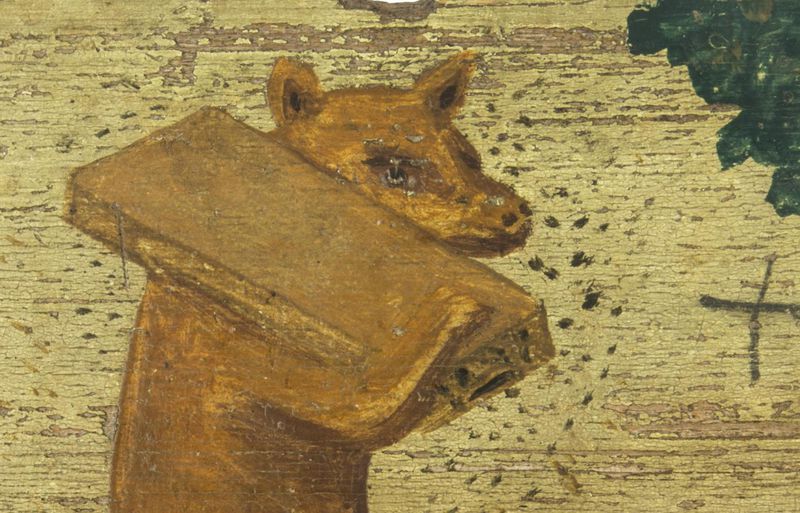
Honey is one of the oldest foods known to man. In large forest areas, honey hunters, known in German as Zeidlers, used to collect honey from wild bee colonies. The name is derived from “Zeideln”, which means cutting out honeycombs. In forest beekeeping, a Zeidler would look for a suitable tree and cut off the branches up to the top. If the trunk was not already hollow, he had to cut holes for the bee dwellings (boxes), which were then closed again with a board. To attract swarms of bees, the entrance hole was coated with a mixture of scents. The boxes were mounted at a height of about 5 metres to protect them from bears.
In house or garden beekeeping, the use of beehives or bee baskets makes it easier to set them up in different locations. Here, the beekeeper not only keeps the bees, but also ensures their reproduction and breeding. Early bee baskets required the honeycombs to be cut out. It was only 160 years ago, when basket beekeeping was replaced by box beekeeping with movable honeycomb frames, that a gentle removal of the full honeycombs became possible.
The box-shaped beehives were put in apiaries. People who did not have an apiary stacked the boxes under the eaves of a farm building or under a makeshift roof. When apiaries became more widespread in Carniola, Carinthia and northwestern Slovenian Styria in the 19th century, front panel painting began to flourish in the process. Only the front panels of the box-shaped beehives, which were usually rectangular, were painted. The panels also had a rectangular recess for the entrance hole in the middle of the lower edge.
The oldest known painted beehive front panel bears the date 1758, attesting to the long tradition that came to an end after 1900. In addition to freehand painting, serial representations using stencil techniques can also be found. The colours are often well preserved, which is probably due to the use of earth pigments and homemade linseed oil. The paintings were commissioned from skilled rural painters or painted by self-taught artists with varying degrees of skill.
Volkskundemuseum Wien houses more than 230 painted beehive front panels. The paintings depict motifs from everyday life and working life, including beekeeping. Religious scenes from the Old and New Testaments and depictions of saints are also frequently found. In addition to entertaining images of dance and music, motifs with mocking content or animals in human roles from the “upside-down world” imagery also stand out. Occasionally, hunting motifs, animal illustrations, technical innovations, historic events and artwork from foreign countries are also shown as decoration.
Nora Witzmann
Curator of the Image, Print and Paper Collection
1 July 2025
